
Last updated
September 7, 2026
TMUA Scores and Scaling Explained: Update for 2026-27
TMUABy
Amelia Calladine
An Introduction to TMUA Scores and Scaling
The TMUA consists of two multiple-choice papers, each with 20 questions. Candidates receive one mark for each correct answer but results are released as a scaled score rather than a raw mark out of 40. The scale runs from 1.0 (low) to 9.0 (high) and is used to standardise candidates' results so that results from different versions and sittings of the test can be compared.
When UAT-UK took over the administration of the TMUA in 2024, the scaling of results was changed. Scores are still reported on a scale of 1.0-9.0, but candidates now receive one combined score reflecting their performance on both papers (previously they would receive a separate score for each paper as well as a combined score). The scale itself has also been adjusted so that the average candidate will receive a lower mark than before.
Ultimately, this has no effect on candidates. The test is not any more difficult than before, and the universities have adjusted their TMUA thresholds according to the new scale. However, candidates using past papers should be aware that their scaled scores on pre-2024 past papers cannot be directly compared to the current scale or university requirements.
Explanation of Scale
In its official explanation of results, UAT-UK states that on their current scale:
- Typical candidates will achieve approximately 4.5
- The top 10% of candidates will achieve 7.0 or higher
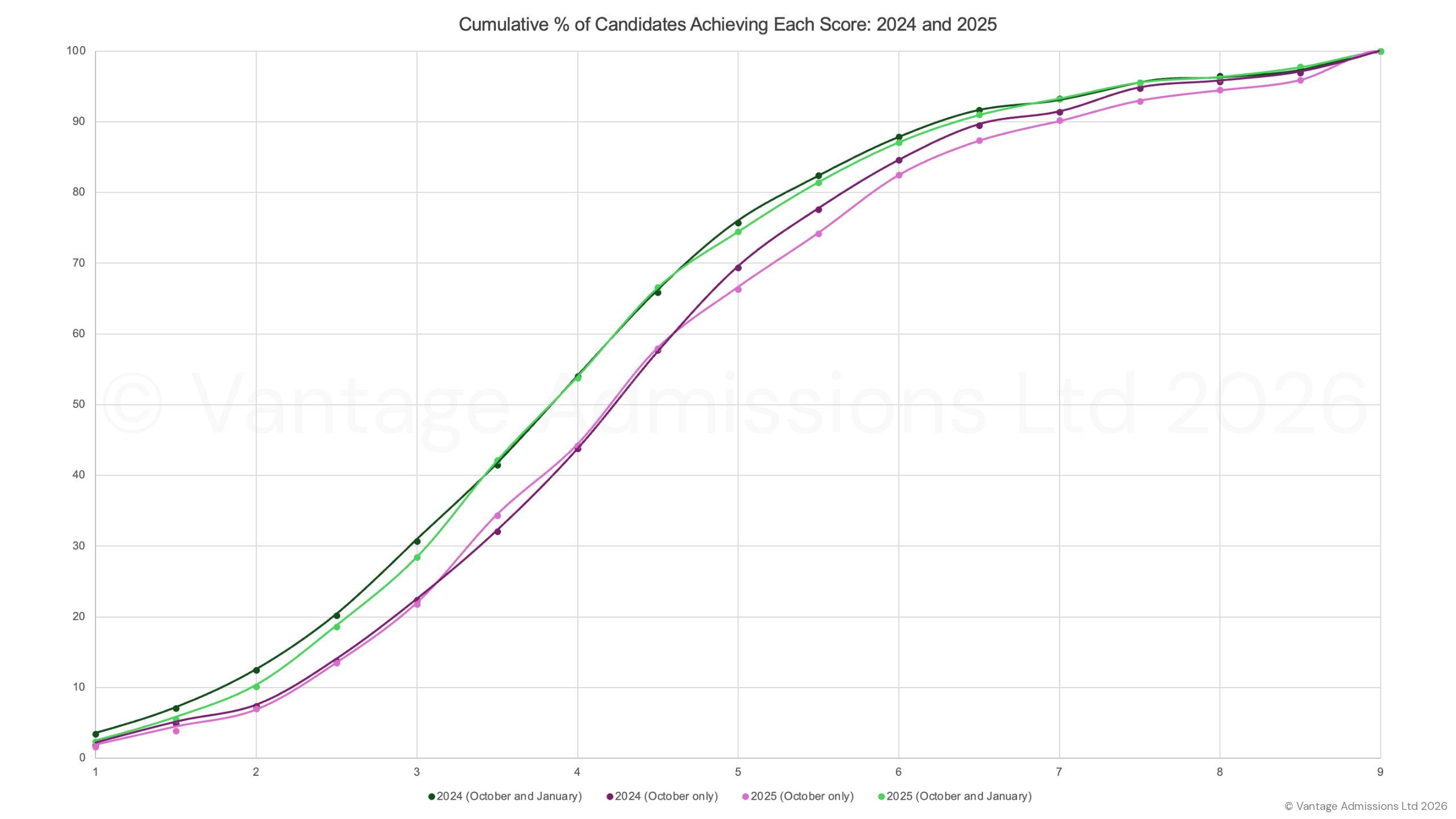
Using data from the UAT-UK distribution of scores, we have plotted a graph showing the cumulative percentage of students achieving each score. UAT-UK releases separate data for the October sitting and combined data for the October and January sittings in each admissions cycle. The scores from the October sitting are higher, not because it was an easier test, but because the strongest candidates who are applying to Cambridge are required to take the first sitting. The combined data for the October and January sittings reveals that UAT-UK's own summary is slightly inaccurate. In practice:
- 50% of candidates achieved approximately 3.8 or higher
- The top 10% of candidates achieved approximately 6.3 or higher
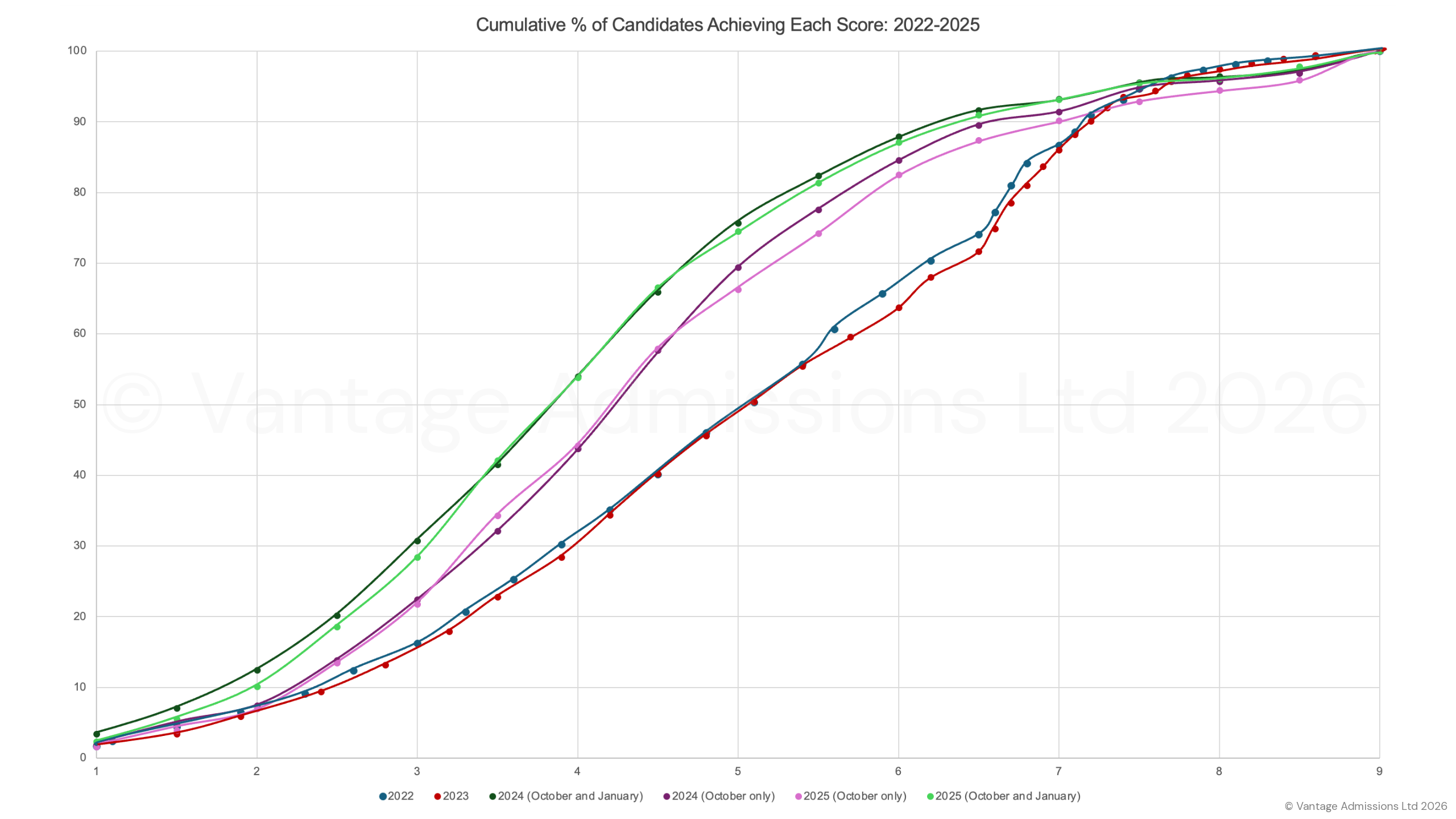
This contrasts to 2022 and 2023, under the old scale, where:
- 50% of candidates achieved approximately 5.2 or higher
- The top 10% of candidates achieved approximately 7.2 or higher
Why Is This Important?
Candidates using TMUA past papers to prepare for their test should be aware that their scaled score on pre-2024 papers will not correspond to the current scale. It will generally be higher than the equivalent performance on the current UAT-UK scale, so they should generally expect to receive a lower score in their real test.
If candidates are aiming for a specific score to meet a university’s published requirement (for example, Durham requires 5.0 for a reduced offer), they should convert their past paper score to the new scale to track their progress and ensure that they are on target for the required score.
To help with this, we have created a simplified graph to convert between the old (pre-2024) scale and new UAT-UK scale. To convert your score:
- Find your past paper score on the x-axis and go up to the 'old scale' curve
- Go horizontally across until you meet the 'new scale' curve
- Go back down to the x-axis to find your converted score
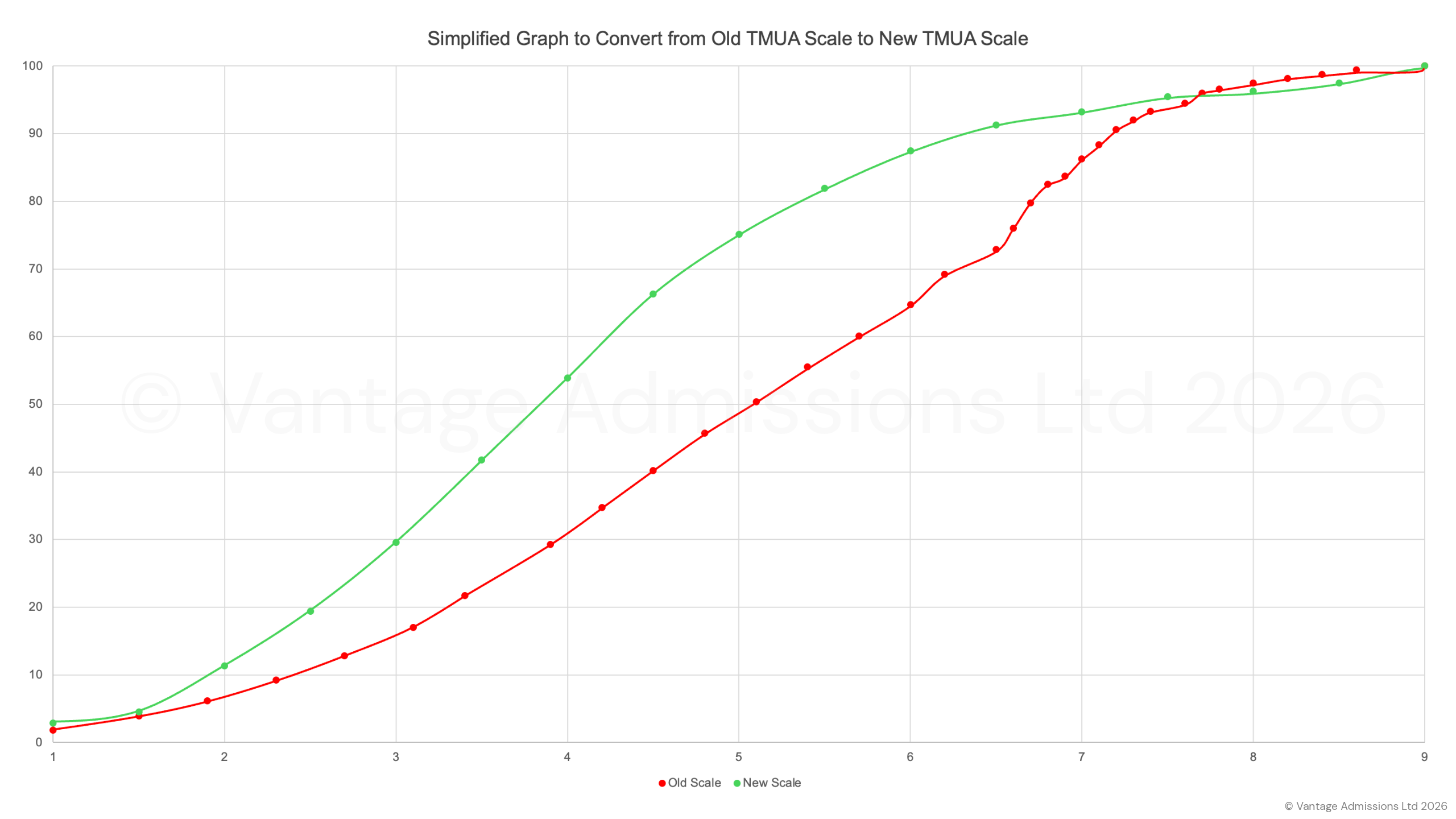
For example, if you achieved a scaled score of 5.0 on a pre-2024 past paper, this would roughly equate to 3.7-3.8 on the new scale.
Sources
UAT UK TMUA Explanation of Results (October 2024 and January 2025)
UAT UK TMUA Explanation of Results (October 2024 only)
UAT UK TMUA Explanation of Results (October 2025 and January 2026)


.svg)
